
Looking Up Coachella Neighbors
Neighbors around a Coachella address are best approached as separate questions: which parcels touch it, who the assessment roll names, whether a deed connects a person to that parcel, and whether a public group offers a contact path. Riverside County evidence is layered. Map My County supplies geometry and APNs, the ACR roll is where owner and mailing information can be inspected, and the recorder index follows named parties. None is a complete list of people in every home.
| Source | What It Shows About a Block | Access |
|---|---|---|
| Map My County | Adjoining parcel polygons, APNs, jurisdiction and map layers | Free interactive viewer |
| ACR property search | Situs, parcel facts and valuation, but not web owner identity | Free online; address, APN or PIN |
| ACR assessment roll | Owner and mailing destination for a selected parcel | Office inspection |
| Recorder index | Named transfer parties, document number, date and legal description | 1974+ online; copies by order |
| City permits and code files | Applicants, work, inspections or notices tied to an address | Current pages or CPRA request |
| Historical reverse directories | Listed address and subscriber or occupant in past runs | Library or archive, in person |
| Voter and community sources | No ordinary voter neighbor list; public contacts and events only | Approved purpose or voluntary publication |
Owner and occupant are not the same. A mailing address is a correspondence destination, not proof that the owner lives at the parcel. Household members, unlisted occupants and people using a protected address may not appear. A Coachella neighbors search pairs a mapped parcel with the narrow record that answers the next question.
Note: A block map establishes neighboring parcels, while a custodian's record supplies the separate facts that can be checked against them.
Coachella Neighbors and the Parcel Map
Map My County is launched from the Coachella City Maps page. The Riverside County viewer can find an address or APN, zoom until parcel polygons display, identify the target, and let the researcher click the polygons beside it. The county's GIS open-data catalog also lists parcel datasets. That is a strong way to define a block, but it is not a household map.
Riverside's assessor search shares the boundary: it resolves an address to a parcel and public characteristics, but owner identity stays off the web. APNs and legal descriptions point the next office to the right lots.
- APN
- An Assessor's Parcel Number, the parcel key used to match map, assessment and deed records.
- Parcel
- A mapped piece of land; it does not equal one home, one household or one resident.
- Situs address
- The location of the parcel, distinct from the address used to send a tax notice.
- Mailing address
- A correspondence destination that may differ from the Coachella parcel address.
Mapping Coachella Blocks by Parcel
Start with one known address and work outward in a set order. The goal is a repeatable parcel trail, not a guess about who is home. Map My County's identify tools and parcel layers make the geographic part concrete.
- Open Map My County from City Maps, search the target address, and zoom until the parcel polygons are clear.
- Select the target parcel, copy its APN, then pan and click every parcel sharing an edge or facing it across the street.
- Record each APN before leaving the map. If a buffer tool is visible, keep it small, export only parcel identifiers, and verify its live labels.
- Take the selected APNs to the ACR assessment roll, then use confirmed party names in the recorder index. A whole-street chain belongs in the Coachella street directory.
Do not turn a map label into a resident claim. GIS can show jurisdiction, zoning, general-plan layers, aerials, roads and districts, but its boundaries are reference data, not a title report. The APN keeps the block precise when polygons cross a road or city edge.
Coachella Neighbor Records at the Counter
The Riverside County Assessor Online Services page is a parcel-routing tool. Its search accepts one key at a time: a property address, an APN, or an Assessment Number, also called a PIN. A PIN uses the first nine digits, with the dash and final digit omitted. The result may show situs, legal description, use, assessed land and improvements, building characteristics, map views and valuation history, but not a web owner-name field.
| Property address | One search key; enter street number and street name. |
|---|---|
| APN | One search key; follow the displayed parcel-number format. |
| Assessment Number or PIN | One search key; use the first nine digits and omit the dash and last digit. |
| Search or Clear | Submit the lookup or reset the fields. |
Owner and mailing information require inspection of the assessment roll at an ACR office. The recorder's document index is name-keyed and begins January 1, 1974. Copies can be ordered; office computers cover 1975-present, and pre-1975 deed research is routed to Gateway Riverside. City permit and code files add applicants, contractors, inspection dates or notices. Current reports drop completed or expired projects, so older material goes through the Coachella public-records portal.
Note: A deed names grantor and grantee, but the APN and legal description are what tie that transfer back to the correct Coachella parcel.
Why Coachella Voter Data Cannot List Neighbors
California's My Voter Status service authenticates the voter. It asks for first and last name, date of birth, and either a California driver-license or ID number or the last four digits of a Social Security number. The returned account information belongs to that registrant: registration status, party preference, polling place, elections and ballot details. It cannot search a nearby address or reveal a neighbor's registration.
Under Elections Code §2194, registration-affidavit information is confidential from routine public terminals and personal, private and commercial uses. Qualified election, scholarly, journalistic, political or governmental users may request a voter file through the Secretary of State request route, or seek county-specific files from the county official. The application states the requester, organization, purpose, geography and requested data, acknowledges restrictions, and requires approval. A private Coachella neighbors search does not meet that ordinary access path.
The California voter-information law provides the legal context for the image below. It describes protected identifiers and authorized uses, not a household roster.
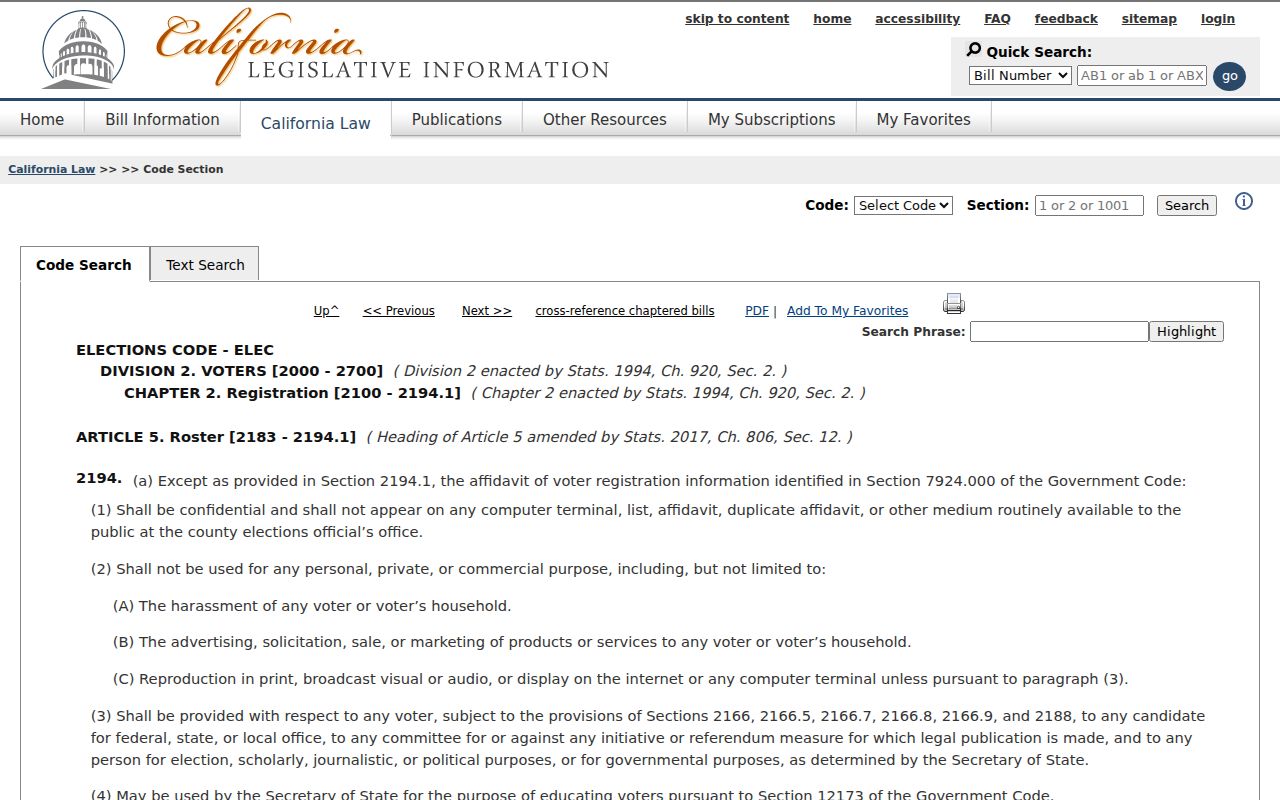
This voter-law image belongs beside the access rule: a street or parcel map cannot be supplemented with a public voter list just because nearby addresses are known.
Note: Authenticated self-lookup and qualified file access are different channels, with different users, fields and lawful purposes.
Coachella Community Contacts for Neighbors
Coachella has no official citywide inventory of neighborhood associations or member directories in the research record. General Plan subareas are planning tools, not lists of residents. Adopt-A-Park and Adopt-A-Street are civic participation routes, while congregations, clubs and neighborhood-watch groups may choose to publish a public contact or event. Their participant rosters remain voluntary and private.
General Plan subareas
Use the city maps for planning geography, not a member list.
City Clerk and requests
The City Clerk and NextRequest handle identifiable existing city records.
Known HOA entity
California SOS bizfile may identify an entity or agent, not its private members.
Public election contact
Riverside Registrar of Voters publishes election contacts, not a block roster.
Ask for a public office, event or meeting, not participant names. Public safety or watch information can be requested from the City or Riverside County Sheriff without seeking volunteer identities.
The Riverside Registrar of Voters contact page is a useful example of a public civic channel, not a residents directory.
The registrar image reinforces the boundary between a public office contact and a private list of who lives near an address.
Coachella Associations and Neighbor Contacts
Current geography can change which public office holds a record. On February 22, 2024, Riverside LAFCO approved adding P7 to Coachella's sphere of influence. Coachella posted the P7 and Mesquite Annexation study and parcel materials from October 2024 onward. A postal label may remain stable while the city, county or planning custodian changes, so an APN and the current jurisdiction matter when requesting a public contact or project record.
That geography does not create an association directory. Identify the parcel, check the General Plan or sphere map, then ask the responsible office for an existing record. Agencies need not make a new list of neighbors or members.
Note: P7 is a records-geography clue, not evidence that every parcel belongs to one association or that residents share one roster.
Official vs Commercial Coachella Neighbor Sources
Official sources answer different parts of the block question and show their limits. Commercial neighbor tools combine deed, marketing and directory data into a report, but the category can confuse an owner with a resident and cannot supply private utility or DMV data. It may also charge for information that still needs checking.
| Source type | Useful for | Important boundary |
|---|---|---|
| County GIS and ACR | Parcel shape, APN, situs, roll inspection and property facts | Not a complete household list; owner data is office-only |
| Recorder, permits and code files | Named transfers, project parties, work dates and notices | Deeds do not prove occupancy; old files may require a request |
| Commercial neighbor tools | A broad lead when a person or parcel name is already known | Owner and resident may differ; accuracy, cost and lawful-use limits remain |
For Coachella neighbors, official sources are slower but clearer about field meaning. Keep the APN, recording number or request number with any commercial lead and verify it against the ACR roll, deed, city file or public contact.
Privacy Limits on a Coachella Neighbor Lookup
A parcel record does not reveal every household member. California DMV data is restricted by the federal DPPA, utility and delivery records carry privacy and security limits, and other occupants do not appear on an ownership roll. Safe at Home provides a substitute mailing address for eligible participants; it is an address-confidentiality program, not erasure of deeds or court filings. Those records need custodian-specific sealing or redaction authority.
Covered businesses may offer California privacy rights such as access, deletion, correction and opt-out of sale or sharing, but public government records follow their own rules. A commercial deletion request does not remove an ACR deed, assessment entry or court file. Check the custodian when a wrong match matters.
California's Megan's Law search is another legal and search context, not a Coachella household roster. The registry carries statutory warnings about misuse and discrimination.
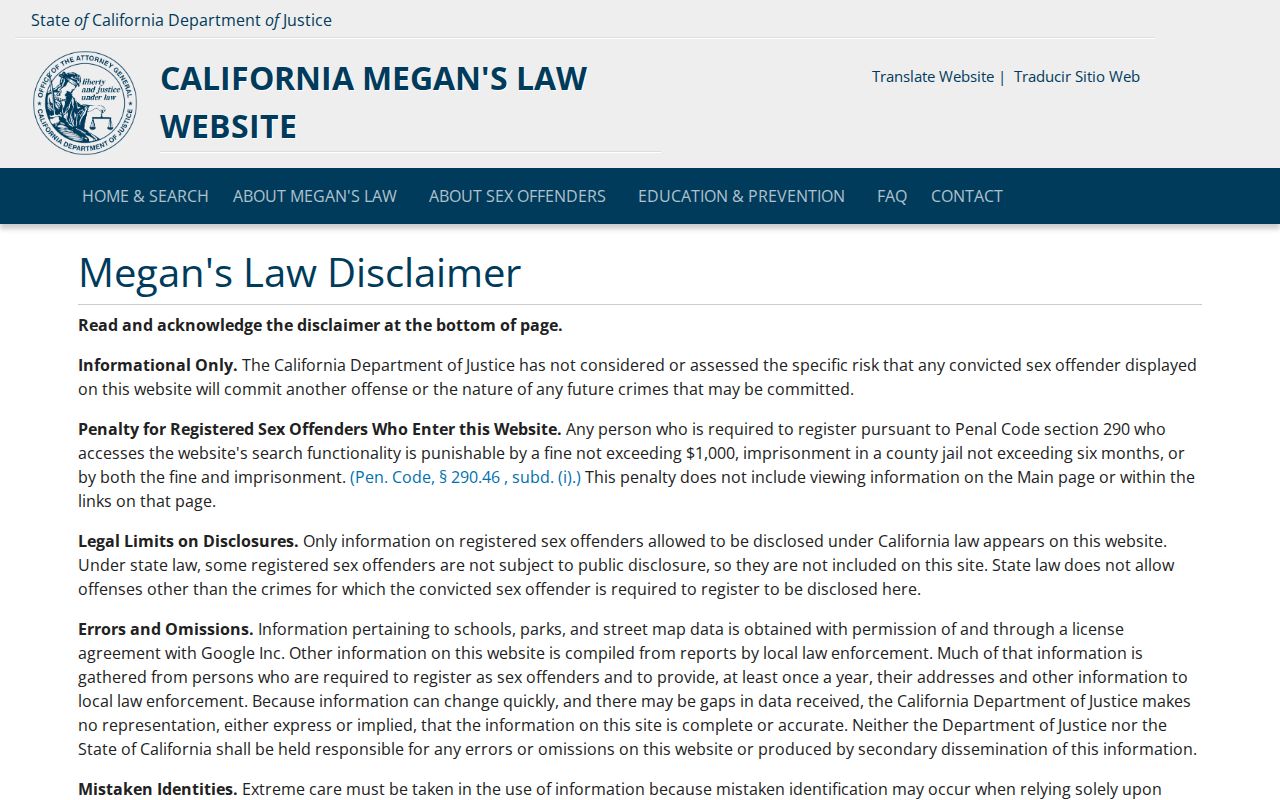
The Megan's Law image belongs with the warning that a public search tool must be used only for its stated legal purpose and never as a map of ordinary neighbors.
Lawful use. Use Coachella neighbor records for personal, lawful research, reconnecting, civic awareness and safety planning. California stalking, criminal-threats, harassment, identity-theft and voter-data laws can apply when records are used to watch, intimidate, deceive or harm someone.