
Coachella ZIP Coverage
Coachella has one verified principal ZIP code: 92236. USPS identifies the Coachella Post Office at 1412 Sixth Street, Coachella, California 92236-9998, with phone number (760) 398-8112. Official city, library and Civic Center addresses use the same ZIP. Its delivery territory may reach beyond incorporated Coachella, so the row below is postal coverage, not a city-limit outline. No official source identifies a separate PO-box-only ZIP or a unique institutional ZIP for Coachella.
| ZIP Code | Areas Covered | Post Office | Notes |
|---|---|---|---|
| 92236 | City of Coachella and postal territory that may extend beyond the municipal boundary | Coachella Post Office, 1412 Sixth Street | Only verified city-serving ZIP in the research |
The single row is useful because it prevents a false impression that Coachella has several verified postal zones. A ZIP code routes mail. It does not identify every parcel under city authority, and it is not an official public resident export. Start with the delivery point, then preserve the APN and jurisdiction that explain where the address sits.
The USPS city and state ZIP lookup is the appropriate city-level check when an address is not yet at hand.
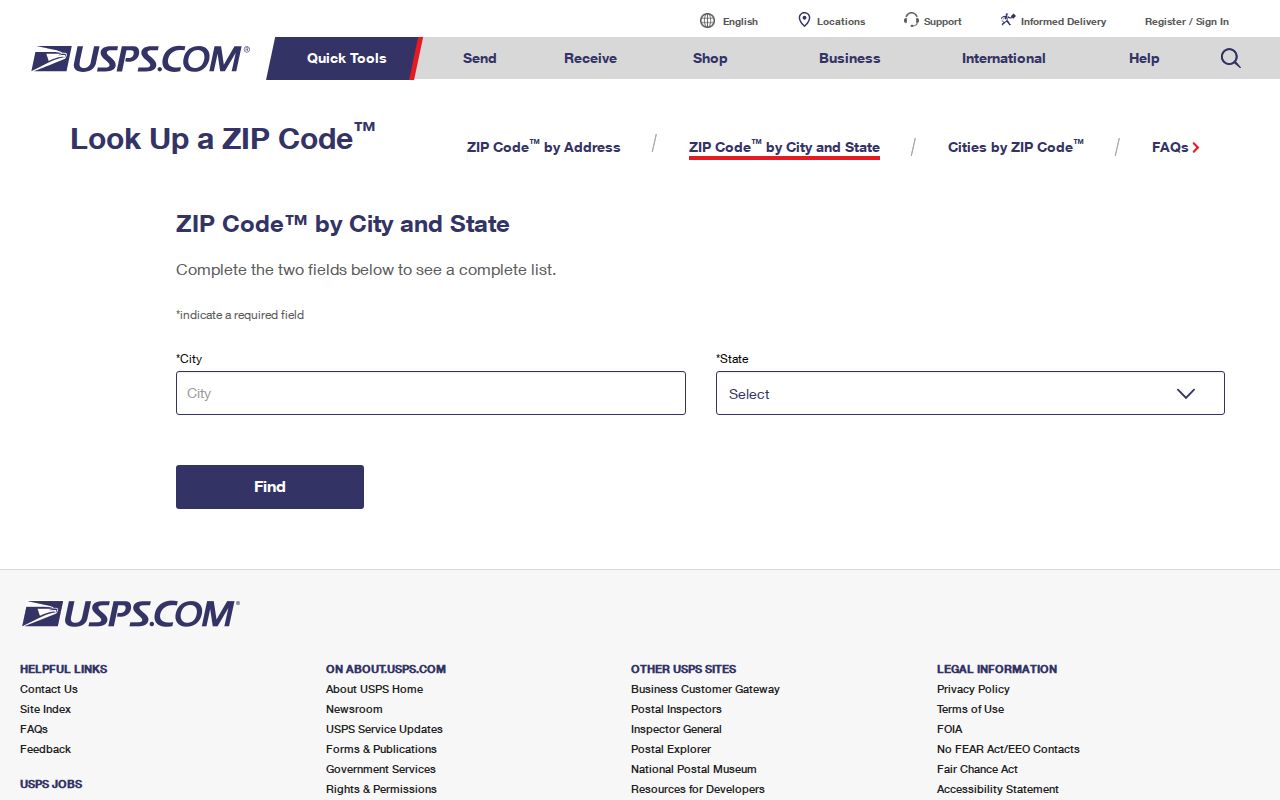
The USPS lookup supports the verified 92236 designation while leaving the separate question of incorporated jurisdiction to Riverside County GIS and city maps.
Coachella ZIP Search Limits
Riverside County’s public portals do not provide a one-click ZIP-wide resident list. The assessor search accepts a property address, APN or PIN, but no ZIP field and no public owner-name search. The recorder index is searched by party name, date, document type or document number, not by ZIP or street address. California My Voter Status has no ZIP field because it authenticates the registrant rather than opening a public neighbor list.
That distinction shapes a defensible Coachella ZIP code directory. An address search can resolve to a parcel, legal description and public property characteristics, while owner identity remains available for inspection at an Assessor-County Clerk-Recorder office. GIS can show parcel geometry and jurisdiction layers. A ZIP-wide result must therefore be assembled from mapped addresses and verified parcels, with any resident conclusion checked against the custodian record rather than inferred from postal labels.
Note: An assessor address result identifies a parcel, not a resident, so keep the search label separate from a household conclusion.
Finding Coachella Residents by ZIP
Finding residents by ZIP code in Coachella is a four-part workflow. USPS answers whether a delivery point uses 92236. The assessor connects a street address to an APN. GIS tests the parcel against incorporated-city and planning layers. Office or qualified-file access supplies the records that a public web search cannot expose. The order matters because a ZIP result alone does not establish a parcel, owner, voter or current resident.
- Verify the mail address. Run the complete street address through USPS and save the standardized city, state, ZIP and ZIP+4 result when returned.
- Resolve the parcel. Enter the street number and street name in the Riverside assessor portal. Record the APN, situs and legal description; do not expect an owner name online.
- Check the map. Open the APN in Map My County, inspect the parcel and jurisdiction layer, then compare the City of Coachella zoning or General Plan maps.
- Use the right fallback. Inspect the assessment roll at an ACR office for owner and mailing information. For voter data, use personal My Voter Status authentication or apply through the qualified California file-request route.
Once a ZIP narrows the address set, the Coachella street directory is the better place to continue street-by-street parcel work.
Coachella ZIP Lookup Fields
USPS documents two useful paths: Lookup by Address for one delivery point, and Lookup by City and State for accepted postal combinations. The next step is Riverside Assessor Online Services, whose documented fields turn a street address into a parcel key. A returned ZIP is an output to preserve, not proof that every parcel or record in the city shares the same boundary.
| Field label | Type | Required | Format or use |
|---|---|---|---|
| Assessment Number (PIN) | Text | One search key | First 9 digits only; omit the dash and last digit |
| Assessor’s Parcel Number (APN) | Text | One search key | Use the parcel number format and follow the displayed guidance |
| Property Address | Text | One search key | Street number and street name, such as 123 Main |
| Search / Clear | Buttons | Not applicable | Submit the search or reset the fields |
No ZIP field appears in the assessor search. Use the city-and-state USPS path for postal validation, then use the address, APN or PIN path for parcel resolution because postal service area and city limits are different systems.
Note: USPS can validate a delivery route, but parcel and city questions still need a separate Riverside lookup.
Coachella ZIP and City Limits
A 92236 result proves postal delivery territory only. Riverside County GIS jurisdiction layers and the City of Coachella’s official zoning and General Plan maps decide whether a parcel is inside incorporated limits. This matters at the city edge and in the sphere of influence, where a mailing city can remain stable while permits, services and records route through the county until a boundary action takes effect.
Four postal terms help keep the result clear:
- ZIP vs ZIP+4
- A ZIP code is the five-digit delivery area; ZIP+4 adds a more precise postal segment within that routing area.
- PO-box ZIP
- A postal code used mainly for post-office boxes or a service location. No separate PO-box-only Coachella ZIP was verified.
- Unique ZIP
- A code assigned to one institution or other single destination. No unique institutional Coachella ZIP was identified.
- Carrier route
- An internal delivery route inside a ZIP, not a municipal boundary, neighborhood, parcel or resident roll.
Coachella ZIP P7 Geography
The P7/Mesquite annexation review shows why postal geography can stay fixed while records jurisdiction moves. The review covered about 78 parcels and about 374 acres between Jackson Street, Avenue 50, near Van Buren Street and Avenue 52. Riverside LAFCO approved the broader P7 sphere-of-influence action on February 22, 2024. Later planning materials add parcel-specific environmental detail, but none of those actions creates a second verified ZIP.
Coachella’s road grid supplies the local clues for spatial work: Harrison, Jackson, Van Buren and Grapefruit Boulevard run north to south, while numbered avenues include 50, 52 and 54, with Airport Boulevard also used in the grid. The Coachella maps page places city zoning and General Plan material beside county parcel resources. Planning can answer map questions at planning@coachella.org or (760) 398-3102 when an address sits near a sphere or annexation study. No official dated citywide street-renumbering project or complete house-number formula was located, so older rural routes and avenue numbers should be checked against the APN and legal description instead of guessed from a modern address pattern.
Postal labels can look exact even when older address history is not. Coachella grew around Southern Pacific rail access and the export of dates, citrus and vegetables, so early records may use rail, farm, irrigation, packing or shipping descriptions instead of a modern house number. The place name itself appears in older Coahuilla and Conchilla forms. For an older parcel, keep the avenue or cross-road, APN, legal description and alternate place spelling beside the current ZIP.
Note: A 92236 mailing label can stay unchanged while a parcel’s city custodian changes after boundary action.
Coachella ZIP Identifiers
Keep four identifiers together when building a Coachella ZIP code directory. The ZIP is the mail-routing label. The situs is the parcel’s physical location. The mailing address is where tax or other notices are sent. The legal description is the title anchor, such as a lot, block and tract or another recorded description. The APN links the parcel to assessor and GIS systems. These labels answer different questions and cannot be swapped.
A mailing address that matches the situs can support a parcel-owner connection, but it does not prove who lives there. A different mailing address shows a correspondence destination, not a resident’s location. Deeds add grantor, grantee, recording number, date and legal description. A spatial directory should preserve those limits and show how each address was mapped, rather than presenting a ZIP list as an official roster.
Coachella ZIP Records Access
The postal counter remains a useful non-web channel. The Coachella Post Office details identify 1412 Sixth Street, Coachella, California 92236-9998, and (760) 398-8112. Use the station information for postal questions, then use the assessor or GIS custodian for parcel questions.
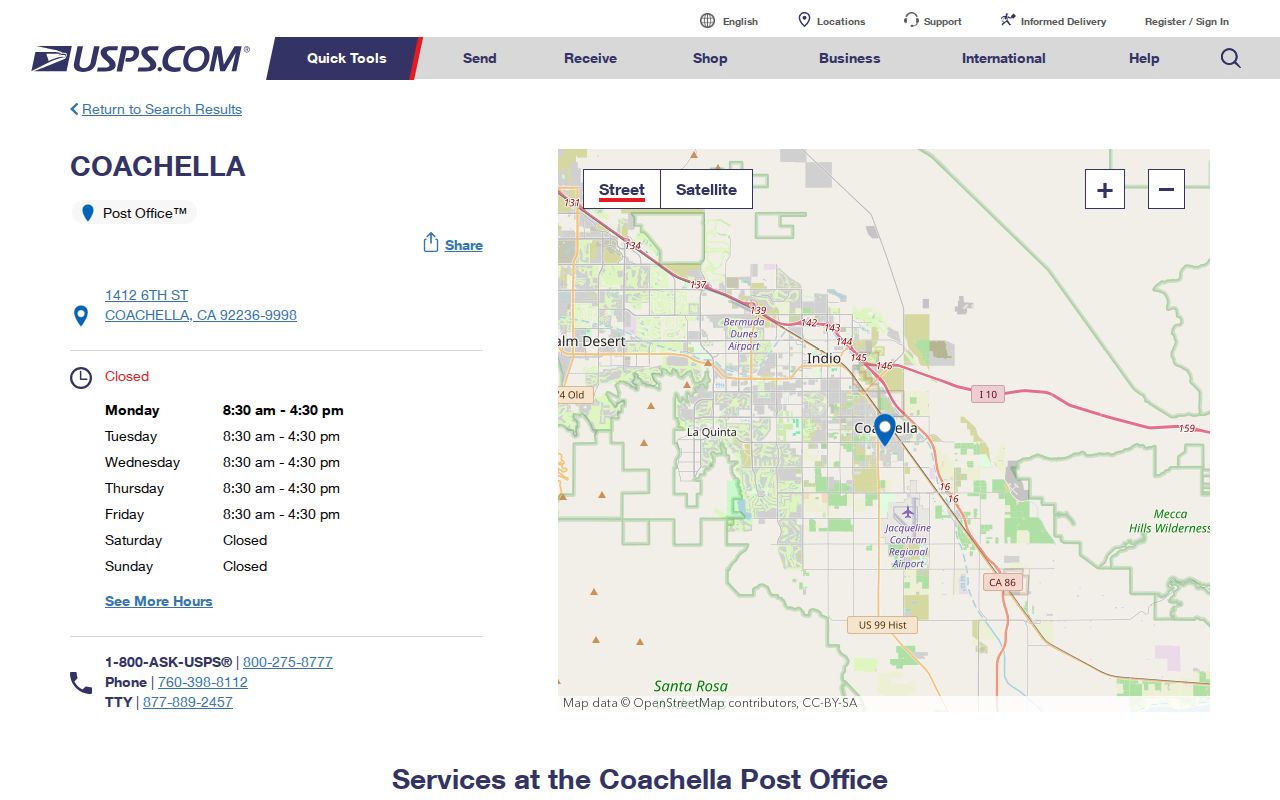
The station record anchors the mailing side of the search. It does not replace a county parcel view or an incorporated-jurisdiction check.
Other access channels fill the gaps between mail and map:
- Riverside County Assessor Online Services accepts an address, APN or PIN. Owner and mailing details require ACR office inspection.
- Map My County supports address or APN identification, parcel clicks, adjacent polygons and live jurisdiction layers; county open data adds parcel datasets.
- The nearer eastern-county ACR counter locations include Palm Desert, while pre-1975 deed research is routed to Gateway Riverside; older material is not assumed to be online.
- California My Voter Status is a private self-lookup. Qualified election, scholarly, journalistic, political or governmental requests use the state voter-file route and remain subject to Elections Code §2194.
Some addresses are intentionally protected. Safe at Home forwards mail but does not erase recorded deeds or court filings, and voter identifiers and signatures remain confidential. California’s CCPA and CPRA give rights against covered businesses, but those rights do not erase public government records. Use public records for lawful personal research, respect custodian limits, and do not turn a postal label into a published resident roster.